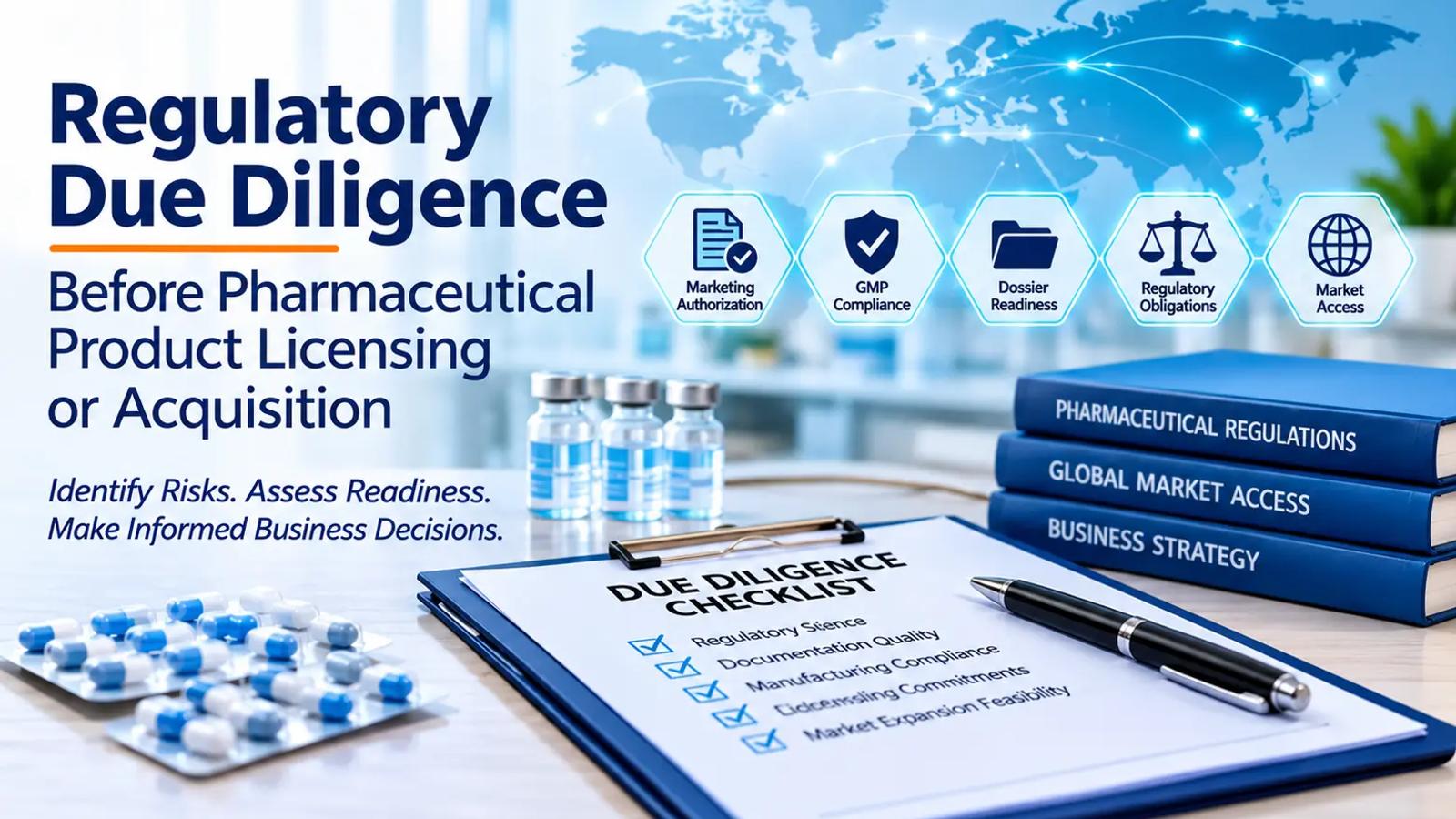
Why regulatory assessment is essential before investing in a pharmaceutical product, acquiring a portfolio, or entering a new market.
In the pharmaceutical industry, a promising product, an attractive licensing opportunity, or an established product portfolio does not automatically translate into commercial success.
Before entering into a licensing agreement, acquiring a pharmaceutical business, or expanding a product into new markets, companies need to understand the regulatory position of the product, the quality of its supporting documentation, and the potential obligations that may affect commercialization.
This is where regulatory due diligence becomes an essential part of pharmaceutical business strategy.
Regulatory Due Diligence
Regulatory due diligence is a structured assessment of a pharmaceutical product, its regulatory documentation, marketing authorization status, manufacturing arrangements, and compliance obligations before a business transaction or market expansion decision.
It helps companies identify regulatory gaps, potential compliance risks, outstanding commitments, and additional work that may be required to support the intended transaction. Depending on the scope of the transaction, the assessment may cover:
- Product registration and marketing authorization status.
- Regulatory dossier completeness and technical consistency.
- Manufacturing site approvals and GMP-related documentation.
- Quality, safety, and efficacy documentation, as applicable.
- Post-approval commitments and regulatory correspondence.
- Intellectual property, product ownership, and transfer-related regulatory considerations.
- Market-specific registration requirements and commercialization readiness.
The objective is not simply to verify whether a product is registered. It is to determine whether the product's regulatory position supports the intended business plan.
Regulatory Due Diligence Important Before a Business Transaction
Pharmaceutical licensing and acquisitions often involve substantial investment, commercial commitments, and long-term regulatory responsibilities. Without an appropriate regulatory assessment, companies may discover critical gaps only after signing an agreement or committing resources.
Key business risks include:
- Unexpected regulatory costs: Missing studies, incomplete documentation, or required remediation may increase the investment needed to commercialize the product.
- Delayed market entry: Regulatory deficiencies, unresolved authority questions, or manufacturing-related issues may affect the planned launch timeline.
- Limited marketability: An existing approval in one country does not automatically establish eligibility for registration in another.
- Unclear regulatory responsibilities: Licensing agreements may fail to adequately allocate responsibility for submissions, variations, renewals, safety obligations, and authority communications.
- Transfer and ownership challenges: Changes in marketing authorization ownership, manufacturing arrangements, or dossier access may require regulatory procedures and contractual coordination.
A structured assessment allows companies to evaluate these risks before finalizing their commercial decisions.
Key Areas to Assess During Pharmaceutical Regulatory Due Diligence
A. Marketing Authorization and Registration Status
The first step is to establish the actual regulatory status of the product in each relevant market.
The assessment should verify:
- Whether the product has an effective marketing authorization or is still under review.
- The approved indication, dosage form, strength, and other relevant product particulars.
- The identity of the marketing authorization holder and the authorized manufacturing sites.
- The status of renewals, variations, and pending regulatory applications.
- Any suspension, restriction, withdrawal, or significant unresolved regulatory issue, where applicable.
Companies should distinguish between an approved product, a pending application, and a product that is merely planned for registration. These situations carry different commercial and regulatory implications.
B. Regulatory Dossier Completeness and Quality
A product may have an existing approval, but the underlying dossier may not be readily available, complete, or suitable for the proposed transaction or additional markets.
A technical review should examine the available Common Technical Document (CTD), electronic CTD (eCTD), or other applicable submission format.
Key areas include:
- Quality and Chemistry, Manufacturing and Controls (CMC) documentation.
- Nonclinical and clinical information, as applicable.
- Manufacturing process descriptions and supporting evidence.
- Responses to previous health authority questions.
- Consistency between approved information and the current product.
The objective is to identify missing evidence, inconsistencies, outdated information, and potential gaps that may require remediation before the product can support the intended commercial strategy.
C. Manufacturing Site and GMP Compliance
Manufacturing arrangements are a critical component of pharmaceutical due diligence. Companies should evaluate the regulatory status of relevant manufacturing and testing facilities, including:
- Applicable manufacturing authorizations and GMP evidence.
- Inspection history and significant observations, where available.
- Open corrective and preventive actions (CAPAs).
- Approved manufacturing sites and any proposed site changes.
- Relevant quality agreements and outsourced manufacturing arrangements.
- Evidence supporting the current manufacturing process and product quality.
A GMP certificate or inspection record alone does not establish that every product-specific regulatory requirement has been satisfied. The assessment should consider both site compliance and the adequacy of the product's supporting documentation.
D. Regulatory Commitments and Outstanding Issues
Previous regulatory correspondence may reveal obligations or risks that are not immediately apparent from the approval certificate. The review should consider:
- Unresolved health authority questions or commitments.
- Pending variations and renewal applications.
- Post-approval studies or other required commitments.
- Product-specific safety or quality-related regulatory actions.
- Inspection findings that may affect manufacturing or commercialization.
- Relevant regulatory correspondence and implementation deadlines.
These obligations should be documented and assigned appropriate ownership during transaction planning.
E. Market-Specific Registration Feasibility
A product approved in one country may require additional data, documentation, testing, or regulatory procedures before it can be registered elsewhere. For each target market, companies should assess:
- The applicable registration pathway.
- Local applicant, marketing authorization holder, or representation requirements.
- Dossier format and country-specific documentation.
- GMP and manufacturing-site assessment requirements.
- Additional data or studies that may be required.
- Expected regulatory fees, consulting costs, and other implementation expenses.
- Post-approval obligations and ongoing maintenance requirements.
Market-entry feasibility should be assessed against the product's current regulatory position rather than assuming that an existing approval can be directly transferred to another jurisdiction.
Regulatory Due Diligence for Pharmaceutical Licensing Agreements
In a licensing arrangement, the parties should establish who owns, controls, maintains, and can access the relevant regulatory documentation and approvals. Important considerations include:
- Dossier access: Will the licensee receive complete and usable regulatory documentation?
- Regulatory responsibilities: Which party will manage submissions, renewals, variations, and authority correspondence?
- Approval ownership: Can the marketing authorization be transferred or otherwise managed under the applicable local procedure?
- Product changes: Who will assess and implement changes to the manufacturing process, specifications, suppliers, or product information?
- Ongoing compliance: Who will be responsible for applicable pharmacovigilance, quality complaints, recalls, and regulatory reporting?
- Commercial territories: Are the intended markets and licensing rights clearly defined?
- Exit arrangements: What happens to regulatory records, approvals, and outstanding commitments if the agreement terminates?
These points should be coordinated with legal, commercial, quality, and regulatory teams. Regulatory due diligence supports the transaction but does not replace legal, financial, intellectual property, or commercial due diligence.
Regulatory Due Diligence for Pharmaceutical Acquisitions
Acquisitions may involve a single product, a portfolio of marketing authorizations, a manufacturing business, or an entire pharmaceutical company. The assessment should therefore consider both individual product risks and portfolio-level implications. For a multi-product portfolio, a structured review can help classify products according to:
- Current approval and lifecycle status.
- Dossier availability and technical completeness.
- Manufacturing and supply-chain dependencies.
- Outstanding regulatory commitments.
- Target-market expansion potential.
- Expected remediation effort and ongoing maintenance requirements.
This approach helps decision-makers prioritize resources, identify potential liabilities, and understand the regulatory workload associated with the acquisition.
Where the transaction involves a change of ownership or control, the applicable notification, approval, or transfer requirements should be confirmed for each relevant jurisdiction.
Turning Regulatory Findings into Business Decisions
The value of regulatory due diligence lies in translating technical findings into actionable business decisions. Rather than producing only a list of missing documents, the assessment should explain the significance of each finding and its potential impact on the intended transaction.
For example, incomplete CMC documentation may require a defined remediation plan. Unresolved regulatory commitments may need to be assigned to a responsible party with clear deadlines. Manufacturing compliance concerns may require further investigation before supply arrangements are finalized.
Similarly, missing dossier access may need to be resolved contractually, while uncertain registration pathways may require market-specific feasibility assessments before expansion budgets are approved.
The findings should support a prioritized action plan covering regulatory gaps, potential costs, implementation timelines, responsible parties, and outstanding decisions. This enables business leaders to assess whether to proceed with a transaction, negotiate revised terms, allocate additional resources, or reconsider the opportunity
A Practical Framework for Regulatory Due Diligence
A structured process can help companies conduct assessments consistently.
- Step 1 — Define the transaction scope: Identify the products, markets, manufacturing sites, and business objectives involved.
- Step 2 — Collect and review documentation: Gather available approvals, dossiers, regulatory correspondence, manufacturing information, and compliance records.
- Step 3 — Assess regulatory gaps: Compare the available evidence against applicable requirements and the intended transaction or market-entry strategy.
- Step 4 — Evaluate business implications: Consider the potential impact on costs, timelines, supply continuity, market access, and ongoing regulatory obligations.
- Step 5 — Prepare a risk-based action plan: Classify findings by significance, identify remediation measures, and allocate responsibilities.
- Step 6 — Support transaction planning: Provide regulatory inputs for negotiations, implementation planning, and post-transaction integration.
The depth of the assessment should be proportionate to the complexity, value, and risk profile of the transaction.
Conclusion
Pharmaceutical licensing and acquisitions create opportunities for growth, portfolio expansion, and international market access. However, the commercial value of a pharmaceutical product depends not only on its market potential but also on the strength of its regulatory position and the feasibility of maintaining or expanding its approvals.
Regulatory due diligence helps companies make informed investment decisions before committing to a transaction. By identifying regulatory gaps, assessing compliance obligations, and evaluating market-specific requirements early, businesses can better anticipate risks and develop realistic commercialization plans.
For pharmaceutical companies seeking to license products, acquire portfolios, or expand into new markets, regulatory due diligence should be an integral part of transaction planning—not an activity postponed until after the agreement is signed.
How RegOrbis Pharma Can Support Your Regulatory Strategy
RegOrbis Pharma supports pharmaceutical companies with regulatory consulting, regulatory gap assessments, CTD/eCTD dossier preparation, CMC documentation, global product registration strategy, and lifecycle management.
Our approach helps companies assess regulatory readiness, identify documentation gaps, and plan practical next steps for product licensing, portfolio expansion, and international market entry.
Planning a pharmaceutical licensing transaction or product acquisition?
Contact RegOrbis Pharma to discuss your regulatory assessment and market-entry requirements.
RegOrbis Pharma — Navigating Regulation and Delivering Trust.
📱 Phone: +91 9967265308 / 9668430491