Introduction
Obtaining a marketing authorization is often viewed as the final milestone before a pharmaceutical product reaches the market. However, from a Regulatory Affairs perspective, approval is not the end of the journey—it is the beginning of an ongoing lifecycle.
Once a product is approved, pharmaceutical companies must continuously manage changes to manufacturing processes, suppliers, specifications, analytical methods, labeling, packaging, safety information, manufacturing sites, and other product-related elements. Depending on the nature and impact of the change, these may require regulatory notification, prior approval, variation submission, or other regulatory action. This ongoing activity is known as post-approval lifecycle management.
For companies operating across multiple markets, lifecycle management can become particularly challenging because the same change may have different regulatory requirements, submission categories, timelines, and implementation conditions in different jurisdictions.
Effective lifecycle management therefore requires more than maintaining compliance. It requires forward planning, regulatory intelligence, cross-functional coordination, and a clear understanding of the commercial impact of regulatory changes.
What Is Post-Approval Lifecycle Management?
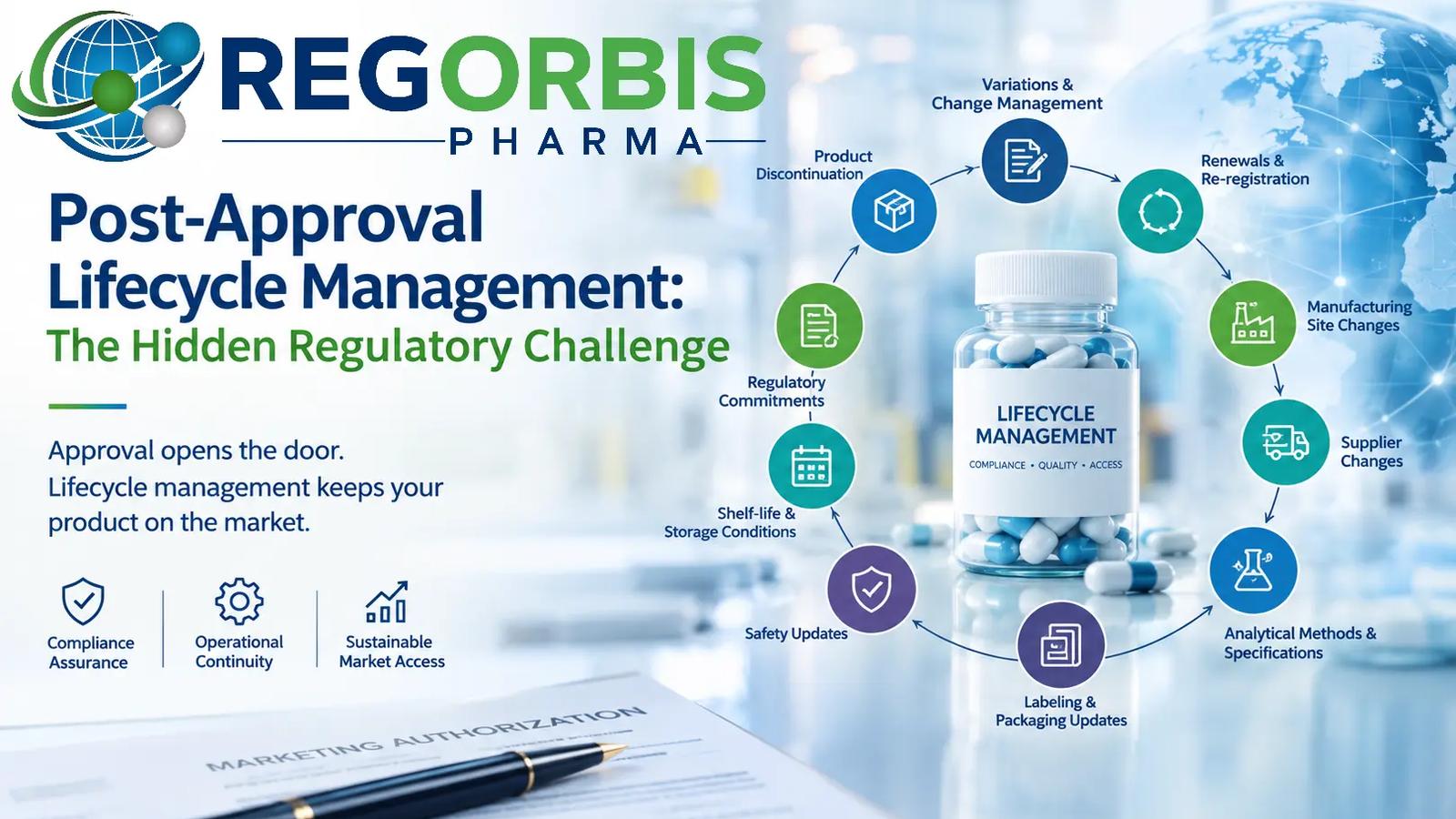
Post-approval lifecycle management refers to the regulatory management of an approved pharmaceutical product throughout its commercial life. It includes activities such as:
- Variations and post-approval changes
- Renewals and re-registration
- Manufacturing site changes
- Changes to API or excipient suppliers
- Manufacturing process changes
- Specification and analytical method changes
- Packaging and labeling updates
- Safety-related updates
- Shelf-life or storage-condition changes
- Regulatory commitments
- Product discontinuation or withdrawal
- Market-specific maintenance activities
The objective is to ensure that the product remains safe, effective, compliant, and commercially viable throughout its lifecycle.
Why Does Post-Approval Management Become a Challenge?
The complexity often increases after approval because pharmaceutical companies may have multiple products registered in multiple countries, each with its own regulatory framework.
A single manufacturing change, for example, could require:
One global change → Multiple regulatory assessments → Different submission requirements → Different approval timelines → Different implementation dates
This creates a significant coordination challenge.
Companies must determine:
- What has changed?
- Does the change impact the registered dossier?
- What regulatory pathway applies?
- Which markets are affected?
- What supporting documentation is required?
- When can the change be implemented?
- Are regulatory approvals required before implementation?
- Are there market-specific commitments or conditions?
Failure to answer these questions systematically can result in regulatory delays, unnecessary rework, or compliance risks.
Common Post-Approval Changes That Require Regulatory Assessment
Manufacturing Changes
Manufacturing processes can evolve for a variety of business and technical reasons, including:
- Capacity expansion
- Process optimization
- Equipment replacement
- Site transfer
- Manufacturing network consolidation
- Process efficiency improvements
Even when a change is technically beneficial, its regulatory impact must be evaluated before implementation.
Supplier Changes
Companies may change suppliers because of:
- Supply-chain constraints
- Cost optimization
- Business continuity
- Supplier qualification issues
- Raw material availability
Changes involving APIs, excipients, packaging components, or other critical materials may require regulatory assessment depending on the market and the nature of the change.
Analytical Method and Specification Changes
Updates to analytical procedures or specifications may arise from:
- Method improvements
- Pharmacopoeial updates
- Improved analytical capability
- Process understanding
- Regulatory commitments
The company must determine whether the proposed change affects the approved dossier and what supporting data are necessary.
Labeling and Artwork Changes
Product information can change because of:
- Safety updates
- Regulatory requirements
- New indications or restrictions
- Manufacturing information changes
- Packaging updates
- Local language requirements
For companies operating globally, maintaining consistency between approved labeling and marketed materials can become a substantial lifecycle-management activity.
Shelf-Life and Storage Conditions
New stability data may support changes to:
- Shelf life
- Storage conditions
- Packaging configuration
However, these changes need appropriate regulatory assessment and supporting stability information before implementation.
The Global Challenge: One Change, Multiple Markets
One of the most overlooked aspects of lifecycle management is that regulatory requirements are not globally identical. A change that can be implemented through a notification in one jurisdiction may require an approval before implementation in another.
For multinational companies, this means that a global change-control process should not stop at technical assessment. It should also trigger a market-by-market regulatory impact assessment.
A practical lifecycle workflow can be viewed as:
Change Identified → Regulatory Impact Assessment → Market Mapping → Data Gap Assessment → Submission Strategy → Regulatory Submission → Approval/Acceptance → Implementation → Dossier Update
This approach helps connect internal change control with external regulatory obligations.
The Business Impact of Poor Lifecycle Management
Post-approval regulatory activities are sometimes treated as administrative work. In reality, they can directly affect business operations. Poor lifecycle management may contribute to:
- Delayed product launches or changes
- Supply interruptions
- Inconsistent implementation across markets
- Additional regulatory queries
- Unplanned regulatory costs
- Rework of technical documentation
- Delays in manufacturing transfers
- Compliance findings
- Difficulty maintaining accurate regulatory dossiers
For companies with large international portfolios, the cumulative impact can become significant. A well-designed lifecycle strategy can therefore support not only regulatory compliance but also business continuity and operational efficiency.
Regulatory Intelligence: A Critical Component of Lifecycle Management
Regulatory requirements continue to evolve. Authorities may introduce new guidelines, update variation procedures, revise documentation expectations, or change implementation requirements. This makes regulatory intelligence particularly important after approval.
Companies should monitor:
- New and revised regulatory guidelines
- Authority communications
- Pharmacopoeial changes
- Safety-related regulatory developments
- Variation classification updates
- Submission requirements
- Regional implementation expectations
Regulatory intelligence allows companies to identify changes early and assess their potential impact on the product portfolio.
Building an Effective Lifecycle Management Strategy
A proactive lifecycle management system should include several key elements.
Maintain an Accurate Regulatory Baseline
The company should know exactly what is currently approved in each market. This includes:
- Approved formulation
- Manufacturing sites
- Specifications
- Manufacturing process
- Packaging
- Labeling
- Shelf life
- Storage conditions
- Approved indications
- Regulatory commitments
Establish a Change-Impact Assessment Process
Every relevant technical or business change should trigger a regulatory assessment. The assessment should determine:
Change → Regulatory impact → Affected markets → Required data → Submission category → Implementation requirements
Maintain a Global Regulatory Change Matrix
For multinational portfolios, a centralized matrix can help track:
- Country
- Product
- Change
- Submission type
- Submission date
- Approval/acceptance date
- Implementation date
- Local requirements
- Outstanding actions
This can significantly improve visibility across the organization.
Integrate Regulatory Affairs with Other Functions
Lifecycle management cannot operate effectively in isolation. Close coordination may be required between:
- Regulatory Affairs
- Quality Assurance
- Quality Control
- Manufacturing
- Supply Chain
- R&D
- Pharmacovigilance
- Medical Affairs
- Packaging
- Commercial teams
Early regulatory involvement can help identify potential regulatory consequences before operational decisions are finalized.
Technology and Digital Lifecycle Management
As pharmaceutical portfolios become more complex, manual tracking of regulatory changes can become increasingly difficult. Digital regulatory information management systems can support:
- Product and registration tracking
- Regulatory commitment management
- Submission tracking
- Variation management
- Document control
- Regulatory intelligence
- Approval status monitoring
- Market-specific lifecycle activities
The objective is not simply to digitize existing processes, but to create greater visibility and control over the product lifecycle.
From Reactive Compliance to Proactive Lifecycle Strategy
A reactive approach typically looks like this
Change occurs → Regulatory team is informed → Impact is assessed → Submission is prepared → Regulatory issue is addressed
A proactive approach is different:
Business/technical change planned → Regulatory impact assessed early → Global strategy developed → Data and documentation prepared → Submission planned → Implementation coordinated
The second approach allows Regulatory Affairs to become an active contributor to business planning rather than functioning only as a compliance checkpoint.
A Practical Post-Approval Lifecycle Checklist
Before implementing a significant post-approval change, companies should consider:
- What exactly is changing?
- Which approved dossier sections are affected?
- Which countries are affected?
- What regulatory classification applies in each market?
- Is prior approval required?
- What supporting data are required?
- Are stability or validation data needed?
- Does labeling or artwork require revision?
- Are regulatory commitments affected?
- What is the expected regulatory timeline?
- When can the change be implemented commercially?
- Are all affected regulatory dossiers and databases updated?
This checklist can help identify regulatory requirements before they become implementation problems.
Conclusion
Marketing authorization is not the destination—it is the starting point of a product's regulatory lifecycle. As products move through commercialization, manufacturing changes, supplier changes, safety updates, labeling revisions, renewals, and other lifecycle events, companies must continuously evaluate their regulatory impact.
For organizations operating across multiple markets, the challenge becomes even greater because regulatory expectations and implementation pathways can differ by jurisdiction.
A proactive lifecycle management strategy can help companies maintain regulatory compliance while supporting business continuity, efficient change implementation, and sustainable market access.
At RegOrbis Pharma, we support pharmaceutical companies with regulatory strategy, post-approval lifecycle management, variations, renewals, regulatory intelligence, dossier management, and global regulatory activities—helping organizations navigate regulatory requirements throughout the product lifecycle.
Regulatory approval may open the market. Effective lifecycle management helps keep the product there.
📱 Phone: +91 9967265308 / 9668430491