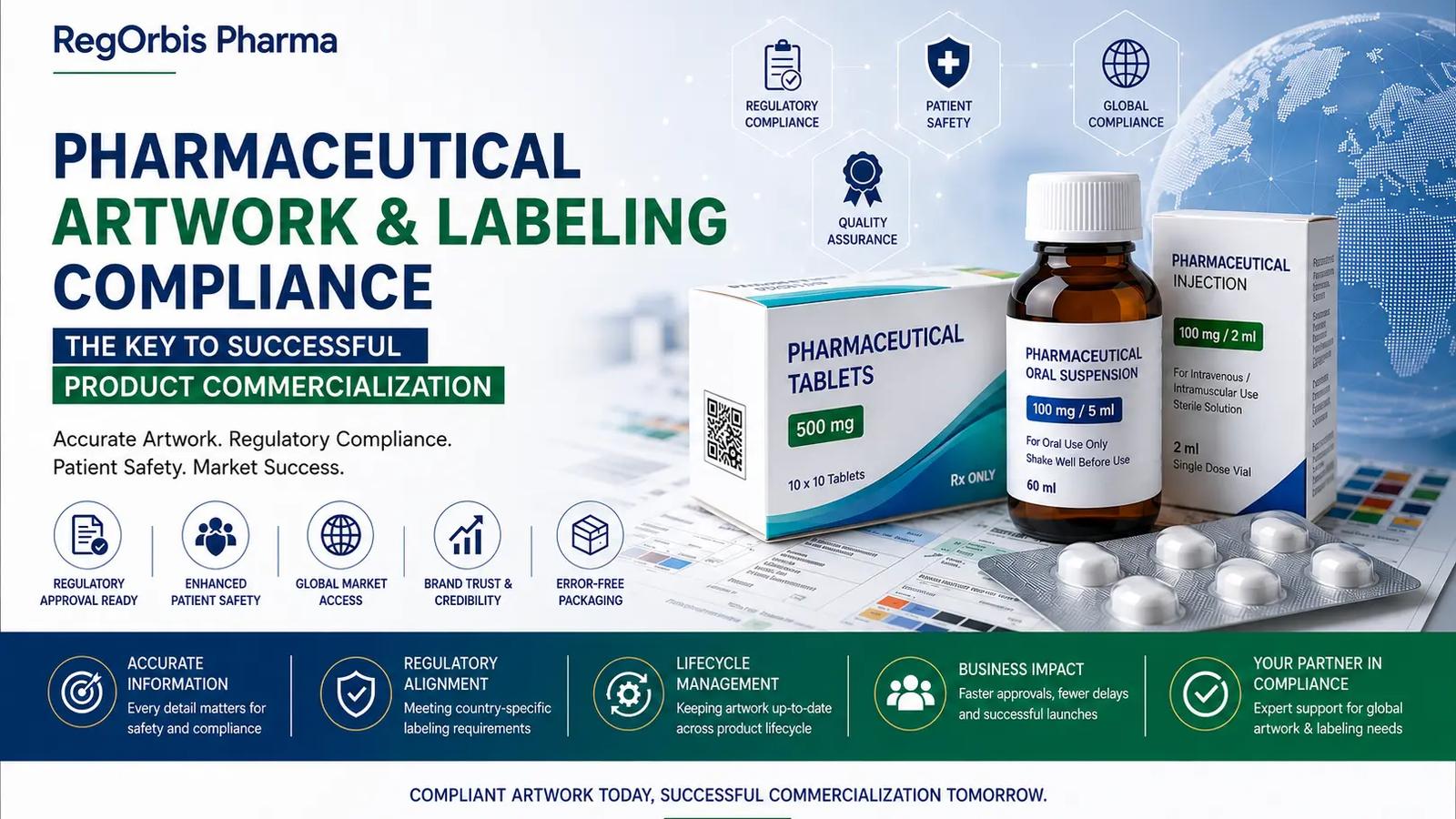
Introduction
In the pharmaceutical industry, product commercialization is not only dependent on formulation development and regulatory approval — it also heavily relies on accurate, compliant, and market-ready artwork and labelling.
Pharmaceutical artwork is much more than packaging design. It is a critical regulatory and patient safety component that communicates essential product information to:
- Healthcare professionals
- Patients
- Pharmacists
- Regulatory authorities
Incorrect or non-compliant artwork can lead to:
- Regulatory rejection
- Product recalls
- Supply chain delays
- Patient safety risks
- Commercial losses
As global regulations continue to evolve, pharmaceutical companies must ensure that product labeling and artwork remain compliant across all target markets throughout the product lifecycle.
At RegOrbis Pharma, we help organizations develop compliant, accurate, and globally aligned pharmaceutical artwork solutions that support successful commercialization and regulatory compliance.
What is Pharmaceutical Artwork?
Pharmaceutical artwork refers to the regulated visual and textual content printed on:
- Primary packaging
- Secondary packaging
- Package inserts
- Labels
- Cartons
- Blister foils
- Leaflets
Artwork includes critical information such as:
- Product name
- Strength and dosage form
- Batch number
- Manufacturing & expiry dates
- Storage conditions
- Safety warnings
- Barcode and serialization details
- Regulatory statements
Why Artwork is Critical for Product Commercialization
1.Regulatory Approval Requirement
Artwork and labeling are mandatory components of regulatory submissions.
Health authorities such as:
- US FDA
- European Medicines Agency
- Medicines and Healthcare products Regulatory Agency
Carefully review artwork to ensure:
- Regulatory compliance
- Proper labeling content
- Patient safety communication
- Non-compliant artwork may delay - Product approvals and market launch
2.Patient Safety & Risk Reduction
Accurate labeling helps prevent:
- Medication errors
- Incorrect dosage administration
- Product misuse
- Confusion between products
Clear artwork improves:
- Product identification
- Safe administration
- Traceability
3. Country-Specific Regulatory Compliance
Each region has unique requirements related to:
- Language
- Labeling statements
- Barcode formats
- Serialization
- Safety symbols
- Packaging dimensions
Examples:
- EU multilingual packaging
- US prescribing information requirements
- GCC Arabic labeling
- ASEAN-specific labeling formats
Failure to localize artwork properly can result in:
- Customs delays
- Regulatory deficiencies
- Import restrictions
4.Commercialization & Market Readiness
Artwork plays a major role in:
- Product launch readiness
- Supply chain continuity
- Packaging operations
- Distribution management
Incorrect packaging artwork may lead to:
- Batch rejection
- Repackaging costs
- Launch delays
- Product shortages
5. Lifecycle Management & Post-Approval Compliance
Artwork must be continuously updated throughout the product lifecycle.
Updates may include:
- Safety labeling changes
- Manufacturing site updates
- Regulatory variations
- Serialization updates
- New regulatory guidelines
Proper artwork lifecycle management helps maintain:
- Continuous compliance
- Market continuity
- Inspection readiness
Key Components of Pharmaceutical Artwork Review
1.Labelling Content Verification
Ensuring all mandatory regulatory text is included.
2. Artwork Technical Review
Verification of:
- Font size
- Readability
- Color contrast
- Barcode placement
- Printing specifications
3.Regulatory Compliance Check
Alignment with:
- Country-specific guidelines
- Pharmacopoeial requirements
- Serialization regulations
4.Medical & Scientific Accuracy
Verification of:
- Indications
- Dosage instructions
- Warnings
- Contraindications
Importance of Serialization & Track-and-Trace
Modern pharmaceutical commercialization requires serialization compliance in many regions.
Serialization supports:
- Anti-counterfeiting measures
- Supply chain security
- Product traceability
Regions with serialization requirements include:
- Europe (FMD)
- United States (DSCSA)
- GCC countries
- Russia and CIS markets
Common Artwork & Labelling Challenges
- Frequent Regulatory Updates - Labelling requirements evolve continuously.
- Multi-Country Packaging Complexity - Different markets require different language and formatting rules.
- Version Control Issues - Poor artwork control may lead to:
- Incorrect packaging release
- Mix-ups between markets
- Tight Commercial Timelines - Artwork approvals often become critical launch bottlenecks.
- Coordination Between Multiple Teams - Artwork development requires alignment between:
- Quality Assurance
- Packaging teams
- Manufacturing sites
Emerging Trends in Pharmaceutical Artwork Management
- Digital artwork management systems
- AI-supported proofreading
- Smart packaging technologies
- Global serialization expansion
- eLabeling and digital leaflets
- Centralized artwork lifecycle platforms
How RegOrbis Pharma Supports Artwork & Labelling Compliance
At RegOrbis Pharma, we provide:
- Pharmaceutical artwork review and compliance support
- Country-specific labelling adaptation
- Packaging text development
- SmPC, PIL, PI preparation
- Serialization and barcode compliance support
- Artwork lifecycle management
- Regulatory variation support for labeling updates
Helping organizations ensure - accurate, compliant, and commercialization-ready pharmaceutical packaging
Conclusion
Pharmaceutical artwork is not just a packaging element — it is a critical regulatory, safety, and commercialization component that directly impacts product approval and market success.
By implementing strong artwork management strategies, companies can:
- Reduce regulatory risks
- Improve patient safety
- Accelerate commercialization
- Maintain global compliance
At RegOrbis Pharma, we help organizations develop compliant and market-ready pharmaceutical artwork solutions that support successful commercialization, patient safety, and global regulatory compliance.
If you need expert support with respect to Artwork and labelling, our regulatory experts are ready to assist
📧 Email: Info@regorbispharma.com
📱 Phone: +91 9967265308 / 9668430491
🌐 Website: www.regorbispharma.com