Introduction
Australia is widely recognized as one of the world's most respected and highly regulated pharmaceutical markets. Products supplied in Australia are regulated by the Therapeutic Goods Administration (TGA), which evaluates medicines for quality, safety, and efficacy before they can be supplied through inclusion in the Australian Register of Therapeutic Goods (ARTG).
For pharmaceutical companies, obtaining TGA approval is more than a regulatory requirement—it is often viewed as a strategic milestone that supports global credibility, strengthens market access opportunities, and demonstrates compliance with stringent international regulatory standards.
However, successful registration requires much more than submitting a dossier. Companies must understand regulatory pathways, sponsor obligations, GMP requirements, dossier expectations, evaluation procedures, and post-approval responsibilities.
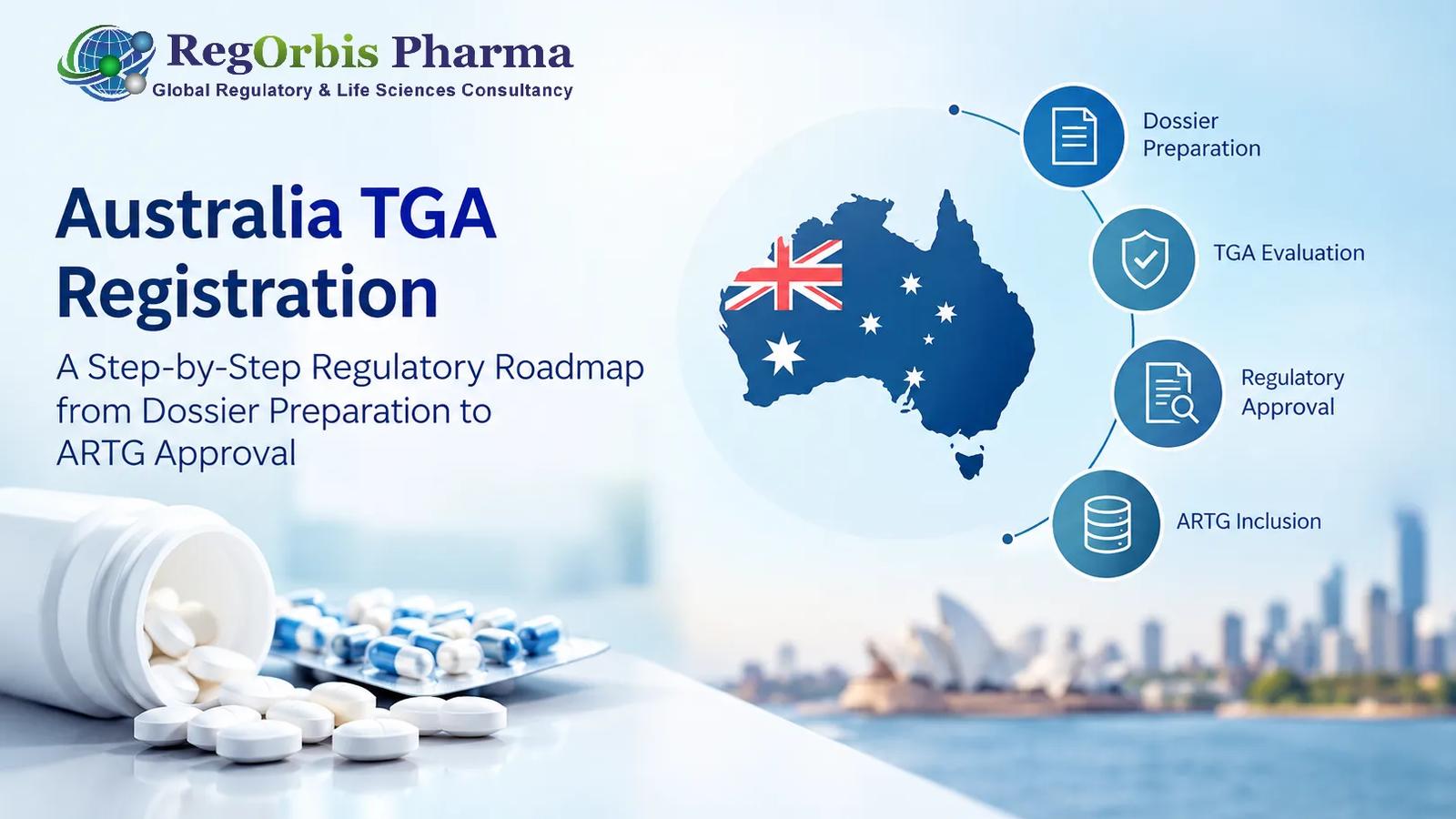
This article provides a practical roadmap for navigating the Australian registration process from early planning through ARTG inclusion and lifecycle management.
Why Australia Matters for Pharmaceutical Companies
Australia continues to attract pharmaceutical manufacturers because of its transparent regulatory framework, strong healthcare system, internationally recognized review standards, and predictable regulatory expectations. For many companies, Australian registration serves as:
- A strategic commercial market
- A highly regulated reference market
- An important component of global expansion plans
- A demonstration of regulatory maturity and product quality
The key to success is understanding how to align regulatory strategy with TGA expectations before the dossier is submitted.
Understanding the Australian Regulatory Framework
The Therapeutic Goods Administration (TGA) is Australia's national regulatory authority responsible for evaluating and monitoring therapeutic goods. Its responsibilities include:
- Evaluation of medicines
- Product registration
- GMP compliance oversight
- Pharmacovigilance monitoring
- Post-market surveillance
- Lifecycle regulatory management
Most prescription medicines must be included in the Australian Register of Therapeutic Goods (ARTG) before they can be legally supplied in Australia. Registration requires submission of supporting data demonstrating quality, safety, and efficacy, together with applicable forms and fees.
The Importance of Regulatory Strategy Before Submission
One of the most common causes of delays is beginning dossier preparation before establishing a clear regulatory strategy. Before initiating a TGA project, companies should evaluate:
- Product classification
- Registration pathway
- Available quality data
- Clinical and bioequivalence requirements
- Stability package readiness
- Manufacturing compliance status
- GMP evidence availability
- Australian-specific requirements
A regulatory gap assessment performed at an early stage often identifies deficiencies that can be resolved before submission, reducing approval risks and review delays.
The Australian Sponsor Requirement
Unlike some jurisdictions, TGA registration requires an Australian sponsor. The sponsor is legally responsible for the product supplied in Australia and acts as the primary point of contact with the TGA. Sponsor responsibilities continue after approval and include maintaining compliance, managing variations, ensuring pharmacovigilance obligations are met, and maintaining GMP evidence where required.
For overseas pharmaceutical companies, selecting the right sponsor arrangement is therefore a critical strategic decision.
Dossier Preparation: Building a TGA-Compliant Submission
Australia generally follows the Common Technical Document (CTD) structure for prescription medicine submissions. The application dossier should provide a complete scientific justification for the product's quality, safety, and efficacy.
Module 1 – Administrative Information
Module 1 contains Australia-specific administrative information, including application forms, product information, labeling documentation, manufacturing information, and sponsor-related documentation.
Module 2 – Summaries and Overviews
This module provides:
- Quality overall summaries
- Nonclinical overviews
- Clinical overviews
- Written summaries
A well-written Module 2 can significantly improve review efficiency by clearly presenting the scientific rationale behind the submission.
Module 3 – Quality Documentation
Module 3 is frequently one of the most heavily scrutinized sections. Typical content includes:
- Drug substance information
- Drug product information
- Manufacturing process descriptions
- Specifications
- Analytical methods
- Validation reports
- Stability data
- Container-closure information
Many regulatory deficiencies originate from weaknesses in this section.
Module 4 – Nonclinical Information
Depending on the application type, Module 4 may contain:
- Pharmacology studies
- Toxicology studies
- Pharmacokinetic studies
Module 5 – Clinical Information
This module contain:
- Clinical efficacy data
- Clinical safety data
- Bioequivalence studies
- Published literature
- Clinical summaries
The extent of data required depends on the registration pathway and product type.
GMP Compliance: A Critical Approval Requirement
Good Manufacturing Practice (GMP) compliance remains one of the most important regulatory considerations during Australian registration.
TGA requires evidence of GMP compliance for relevant manufacturing activities associated with both drug substances and drug products. For overseas manufacturers, this often involves GMP clearance requirements. Approval can be delayed or prevented if valid GMP evidence is not available. Manufacturers should ensure:
- GMP compliance is current
- Manufacturing activities are properly documented
- Quality systems are robust
- Supplier oversight is established
- Data integrity expectations are met
Companies frequently underestimate the time required to obtain or maintain GMP-related documentation.
The TGA Registration Process: Step-by-Step
The TGA registration process follows a structured milestone-based approach consisting of multiple phases designed to ensure a rigorous scientific review while maintaining predictable timelines.
Step 1 – Pre-Submission Planning
The process typically begins with pre-submission planning. During this stage, applicants identify:
- Application type
- Product characteristics
- Submission scope
- Regulatory pathway
- Supporting data package
This phase allows both the applicant and TGA to plan resources and establish evaluation timelines.
Step 2 – Submission of Application and Dossier
The applicant submits:
- Application forms
- CTD/eCTD dossier
- Supporting scientific data
- Administrative documentation
- Applicable fees
The submission should contain all necessary information because opportunities to introduce new data later in the process are limited.
Step 3 – Administrative Screening and Effectiveness Review
TGA assesses whether the submission meets regulatory requirements and can be accepted for evaluation. Applications may be considered:
- Effective and accepted for evaluation
- Not effective and rejected from evaluation
Incomplete or poor-quality dossiers may fail at this stage.
Step 4 – First Round Scientific Assessment
The dossier undergoes detailed evaluation. Depending on the product, assessments may include:
- Quality evaluation
- Clinical evaluation
- Nonclinical evaluation
- Bioequivalence evaluation
The objective is to determine whether the product satisfies Australian requirements for quality, safety, and efficacy.
Step 5 – Section 31 Questions
During evaluation, TGA may issue requests for additional information under Section 31 of the Therapeutic Goods Act. These requests often involve:
- Quality clarifications
- Manufacturing questions
- Stability issues
- Clinical explanations
- Bioequivalence concerns
The quality of the response package can significantly influence review outcomes.
Step 6 – Applicant Response Phase
The sponsor prepares and submits responses addressing all identified deficiencies. Responses should be:
- Scientifically justified
- Consistent with the dossier
- Comprehensive
- Clearly referenced
Weak responses often lead to additional review challenges.
Step 7 – Second Round Assessment
TGA reviews the submitted responses and determines whether outstanding concerns have been adequately addressed.
Step 8 – Expert Advisory Review (When Required)
For certain applications, independent expert advisory committees may provide scientific advice to support decision-making.
Step 9 – Regulatory Decision
Following completion of evaluations, a delegate makes a final decision regarding approval or rejection of the application. Special conditions may also be applied where appropriate.
Step 10 – ARTG Inclusion
Following completion of the regulatory evaluation, the TGA delegate makes the decision on registration. If the application is approved, TGA includes the medicine in the Australian Register of Therapeutic Goods (ARTG). The ARTG entry is associated with the Australian sponsor, who remains responsible for maintaining the entry and fulfilling ongoing regulatory obligations.
Common Deficiencies Observed During TGA Reviews
Many review delays arise from recurring issues such as:
- Incomplete CMC documentation
- Insufficient stability data
- Impurity-related concerns
- Weak analytical validation packages
- Inadequate specification justification
- GMP compliance gaps
- Inconsistent dossier information
- Bioequivalence deficiencies
- Labeling issues
Many of these issues can be identified and corrected through a structured regulatory readiness assessment before submission.
Registration Is Not the End: Lifecycle Management
Approval is only the beginning of the product's regulatory lifecycle. Companies must continue to manage:
- Variations
- Renewals
- Site transfers
- Manufacturing changes
- Formulation changes
- Label updates
- Safety reporting
- GMP maintenance
A proactive lifecycle management strategy helps maintain compliance and uninterrupted market access.
Key Questions Every Company Should Ask Before Submission
Before initiating a TGA submission, organizations should ask:
- Is our regulatory pathway clearly defined?
- Is our dossier submission-ready?
- Are our CMC documents aligned with TGA expectations?
- Have all manufacturing sites been assessed for GMP compliance?
- Are stability data sufficient to support the proposed shelf life?
- Have we identified potential regulatory gaps before submission?
- Is our response strategy prepared in case of regulatory questions?
The answers to these questions often determine whether a review proceeds efficiently or encounters significant delays.
How RegOrbis Pharma Can Support Your Australian Registration Strategy
Expanding into Australia requires more than regulatory knowledge—it requires a well-planned strategy that integrates quality, compliance, scientific data, and business objectives.
At RegOrbis Pharma, we support pharmaceutical and life-science organizations with:
- Australia market-entry strategy
- TGA regulatory pathway assessment
- CTD/eCTD dossier preparation and review
- CMC documentation support
- GMP readiness assessment
- Regulatory gap assessments
- Deficiency response support
- Lifecycle management and post-approval activities
Our objective is to help clients identify risks early, strengthen submission quality, and navigate complex regulatory requirements with confidence.
Conclusion
Australia remains one of the most attractive and respected pharmaceutical markets globally. However, successful registration requires more than assembling a dossier.
Companies must demonstrate product quality, safety, efficacy, GMP compliance, and regulatory readiness through a structured and scientifically robust submission.
Organizations that invest in early regulatory planning, high-quality documentation, effective gap assessments, and proactive lifecycle strategies are often better positioned to achieve efficient reviews and long-term market success.
For pharmaceutical companies seeking Australian market entry, understanding the TGA process is not simply a regulatory requirement—it is a strategic investment in successful commercialization.
Is Your Product Ready for the Australian Market?
Whether you are preparing your first TGA submission, planning a generic product registration, evaluating a new market-entry opportunity, or managing post-approval changes, a strong regulatory strategy can significantly reduce approval risks and delays.
Connect with RegOrbis Pharma to assess your TGA registration readiness and build a regulatory roadmap tailored to your product and business objectives.
📱 Phone: +91 9967265308 / 9668430491